TL;DR
Computational psychiatry has the tools to start unbundling psychiatry’s umbrella diagnoses, but its models still need rigorous, patient-facing trials before they reach the clinic.
Background
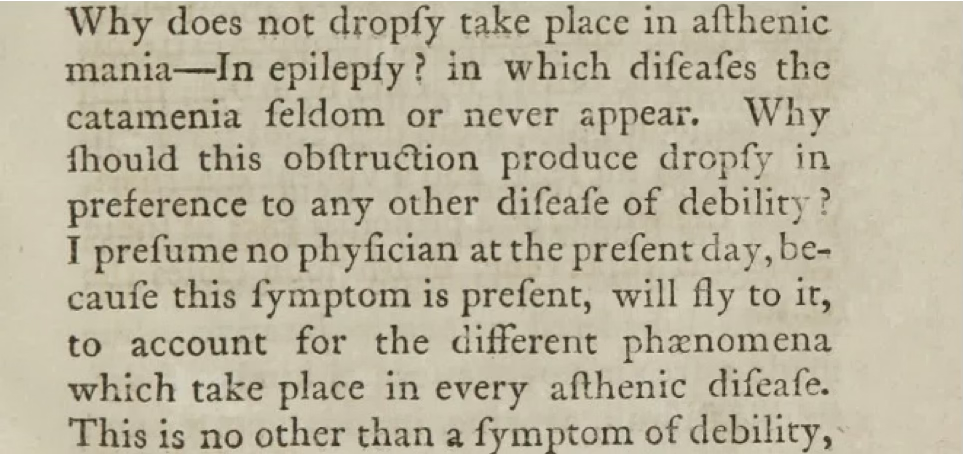
“This is no other than a symptom of debility… I presume no physician, at the present day, because this symptom is present, will fly to it, to account for the different phenomena which take place in every asthenic disease.” (Perkins 1791)
This extract from Elijah Perkins’ 1791 graduation dissertation argues that ‘universal dropsy’ (the former medical term for generalised oedema) is not in itself a disease as once thought, but rather a symptom of various underlying pathophysiologies. He challenged physicians to explain why some asthenic syndromes (conditions marked by debilitation) resulted in dropsy, and others didn’t. As he would argue, medicine simply didn’t yet understand the mechanisms at play.
This rethinking of oedema represents the process of nosology, the constantly evolving classification of disease. As umbrella diagnoses get unbundled, medical treatment of disease can narrow in on and treat the exact biomolecular mechanism at fault. Since Perkins’ dissertation, medicine has discovered the distinct dysfunctions of the heart, liver or kidney which lead to oedema, and the pharmacological options capable of correcting it.
Putting dropsy and other time-stained literature aside, 21st Century medicine is experiencing a nosological revolution of its own, namely in the field of psychiatry. The rampant acceleration of computational resources has gifted neuroscientists new tools to query the mind, enabling them to shed light on the varying neural underpinnings of age-old disorders like schizophrenia and depression.
ETH Zurich’s Computational Psychiatry Course 2026 (Translational Neuromodeling Unit 2026) brought together world-leading researchers and clinicians in the field, offering them the platform to share what progress has been made. Throughout the intense week of presentations and practicals, I took note of the key learnings which the broader medical community should understand.
What role could computational psychiatry have in practice?
The week was introduced by organiser and esteemed researcher Prof. Dr Klaas Enno Stephan, who intended to clarify one thing: Their work isn’t intended to replace the diagnostic expertise of psychiatrists. As a definition, computational psychiatry involves developing patient-specific models of brain function, or ‘computational assays’, in such a way to allow individualised patient care and prognosis, as per the ideals of precision medicine.
As a psychiatrist himself, Stephan understands that mixing technology with this traditionally complex medical subspecialty, where human interaction and emotional intelligence is most pertinent, can be challenging. For some old-school psychiatrists, it’s like mixing water and oil.
Currently, the basis of psychiatric disorder classification is the much-maligned DSM-5. As presenter Dr David Benrimoh put it, the DSM-5 is far from perfect but offers the best current common language between psychiatrists, providing some framing to capture the ineffable aspects of patient behaviour.
But the DSM-5 rarely mentions mechanisms, only symptoms, thus presenting the very same dilemma Perkins tackled in our 18th Century understanding of oedema.
Diagnostic methods should be both reliable (consistent across clinicians and patients) and valid (meaningful and correct), and the DSM is shaky on both. On reliability, 2013’s DSM-5 field trials had two clinicians independently diagnose the same patients. Agreement was poor for some of the most common diagnoses: κ ≈ 0.28 for major depressive disorder, κ ≈ 0.20 for generalised anxiety disorder, and essentially zero for mixed anxiety-depressive disorder (Regier et al. 2013). On validity, reanalysis of the STAR*D trial found that symptom clusters within the one diagnosis responded differently to specific drugs (Chekroud et al. 2017), suggesting that the DSM label groups together patients who differ in ways that matter for treatment.
Framing technology as a means of augmenting the DSM-5 offers a clearer path for technological integration: on a per-patient basis, can it quantify risk of future diagnosis? Forecast the most appropriate drug regimen to prescribe? Or even identify the optimal target region for non-invasive brain stimulation?
Here’s one study which offers reason to be optimistic: using only resting-state fMRI from 906 UK Biobank participants, Galioulline’s 2023 study (Galioulline et al. 2023) predicted who would have a depressive episode within the next three years with about 62% accuracy (p < 0.001). This is without considering the complex symptom profile and lifestyle factors yielded by a psychiatrist during history taking. Yes, psychiatrists should make the final clinical decisions, but why not equip them with this additional predictive power?
Cognitive models require simplification
A generative model of the brain is to a psychiatrist what a map is to an explorer. It is a simplification of a larger system, much too detailed to explain entirely. As Jorge Luis Borges put it, “a map of the empire whose size was that of the empire [is] useless” (Borges 1998). And so of course, the brain is far too complex and chaotic to model in full.
Cognition doesn’t happen in isolation: it plays out in an ever-changing environment, shaped by interacting regions and networks. The presenters were the first to admit that their models are too simple to entirely factor this in. As George Box put it, “all models are wrong, but some are useful”.
Much of the week was spent on what those useful simplifications look like. Days 2 to 4 moved from the statistical groundwork (building generative models and fitting them with Bayesian inference) to models of how we learn, perceive and decide, and finally to models of how brain regions influence one another (dynamic causal modelling, or DCM).
Removing the jargon, this was the common pattern: give a patient a behavioural task, fit a model to how they perform, and pull out a handful of interpretable parameters: how quickly they update their beliefs, how much they trust their senses versus their expectations, how volatile they believe the world to be. Those parameters can then be compared across diagnostic groups.
But how can we use these parameters in a clinically relevant way? Can a patient’s ‘learning rate’ or ‘belief volatility’ be as clinically informative to a psychiatrist as an ECG reading is for a cardiologist?
Some of the presented preliminary findings are worth sharing. Autistic adults appear to overestimate how volatile their environment is (Lawson et al. 2017). People who hear voices seem to lean too heavily on prior expectations, so the brain “hears” what it expects (Powers et al. 2017). And psychosis is framed as an imbalance between trust in sensory evidence and trust in prior beliefs (Goodwin et al. 2023). If these parameters aren’t yet clinically relevant, they at least provide insight into psychiatric disorder mechanisms, the key missing piece of the DSM.
But there is a catch. These differences hold at the group level but don’t yet separate one patient from the next. Worse, the same reliability problem I raised about the DSM applies here too: speakers Ryan Smith and Woo-Young Ahn both noted that a person’s estimated learning rate can barely correlate from one task to another. Before these parameters can guide an individual diagnosis or prescription, they need to prove themselves reliable in the long-term studies the field is calling for.
Translation requires more rigorous clinical trials
During a break in presentations, I asked one of the PhD candidates in Stephan’s Translational Neuromodeling Unit how their work reaches patients: for now, it mostly doesn’t. As far as he knew, the group had no clinical sessions feeding into its research and no ongoing data collection. Much of its modelling runs on datasets collected much earlier. That contrasts with labs like NeuroRestore, where engineers and clinicians run trials side by side with patients.
That said, he was clearly bullish about the clinical potential of his lab’s work: we may soon be using generative models to capture how individual patients behave, then feeding the resulting parameters into models that forecast which treatment path suits which patient.
I actually posed this same question to the closing panel. David Benrimoh agreed that prognosis and subtyping are the likeliest first clinical wins. He added that, for clinicians to trust them, model parameters must be meaningful and interpretable for the individual patient in front of them (not just significant at population level), and that proving this requires long-term studies the field is still short of funding for. Mathias Pessiglione stressed that adoption depends on psychiatrists seeing these tools as augmenting their judgement, not replacing it, and that researchers should be taking their questions from clinicians in the first place.
Others pointed to obstacles outside the lab. Munmun De Choudhury argued that the technology is largely ready, and that public sentiment towards AI and questions of legal liability are now the bigger barriers. Woo-Young Ahn noted that most tasks are run in the artificial setting of a laboratory, and that we don’t yet know whether a person’s parameters are stable from one hour or day to the next. Sophie Valk admitted that clinical translation is not always front of mind for an academic, but that supporting PhDs and extending a lab’s existing line of work through grant proposals is.
As a counter-example, Benrimoh’s own group has trialled a decision-support tool for depression, which produced more remitters than standard care and has been cleared as a medical device by Health Canada (Benrimoh et al. 2025). It shows that rigorous trials can move these tools into clinics.
Finally, there was one theme that ran through almost every lecture: heterogeneity within a given diagnosis. Traditionally in scientific research, clean distinctions between subject groups (eg. control vs diagnosed) make for cleaner contrasts and more significant results. But as we’ve established, the name of computational psychiatry’s game is to capture this variability rather than iron it out. Marta Garrido is moving her work on psychosis toward a spectrum disorder rather than a binary, and Valk’s work looks across diagnoses rather than within them.
Perkins suspected that dropsy was a sign of something deeper, but it took generations of clinical work to find out what. Psychiatry may be at a similar point. The tools to unbundle its umbrella diagnoses are arriving, but only rigorous patient-facing trials will show which of them hold up.